Showing posts with label dlr Libraries. Show all posts

Tuesday, November 11, 2014

We have added some great new BBC magazines to our collection on Zinio Digital Magazine Collection. 

Zinio Digital Magazine collection is available through dlr Libraries website  for our users to browse and download. Over 50 titles are available covering everything from food to computers, to music and art. Titles include 'Marie Claire', 'New Scientist', 'Ideal Home' and many more. We have now added some new BBC Magazines. 


BBC Easycook   
BBC Good Food Magazine   
BBC History Magazine   
BBC Music   
BBC Top Gear Magazine   
BBC Wildlife Magazine   
Countryfile Magazine   
Focus   
Gardeners' World   
Sky at Night  

To access the magazines just log onto http://libraries.dlrcoco.ie/online-library/read-magazines-online  and using your library card number and pin you can read and browse a wide variety of the latest editions.
Last month the three most popular titles were HELLO, New Scientist, and Good Housekeeping UK


Monday, October 20, 2014


dlr Libraries will be closed from Saturday 25th October 2014 to Monday 27th October 2014 inclusive. All libraries will open again on Tuesday 28th October 2014.
Dun Laoghaire library (DRL Lexicon) @ OHD. 
Posted on 
This is the biggest public building project undertaken in the DLR area for over a hundred years. The library, with its children’s reading and art rooms, meeting areas, café and a small theatre, all housed in one huge wedge shaped building, is perched on an extraordinary site.
I’m just a simple art historian- not an architectural critic at all- happy enough speaking about historic architecture from the medieval period up to about the 1950s, but badly out of my depth on contemporary architecture. So I won’t try. Far better anyway to let this amazing new building speak for itself.   Whatever about external consideration, this new library triumphs as a piece of architectural design.
Savour, and behold, the new DRL lexicon public library…
DRL Lexicon public library 15
Along with smaller more intimate reading,  study and meeting spaces,  in many parts of this building is a great sense of scale and of spectacle. 
DRL Lexicon public library 2
the entire landscape around the library has been reshaped and re-landscaped.  The hope is that this will provide a new route through the town and towards the seaside and the adjoining park.
DRL Lexicon public library3
DRL Lexicon public library 4
Senior architect for DLR, Bob Hannan, shows visitors around today.
DRL Lexicon public library 5DRL Lexicon public library 6
Obviously in public buildings, durability of materials is a key concern. It’s early days, but aesthetically at least the mix of warm timbers and concrete is highly successful. 
DRL Lexicon public library 8
I loved the see-through views and the reveals of different angles and views.
DRL Lexicon public library 9
DRL Lexicon public library 10
DRL Lexicon public library 11
In such a favoured location, framing the amazing views around the town and the coast was naturally a priority, while at the same time keeping enough space for the many thousands of books and for reading spaces.   Again, the architects seem to have got the balance right.  Here, below,  looking SE, towards Sandycove and the iconic 40 Foot
DRL Lexicon public library 7

DRL Lexicon public library 12
Regular readers of this blog will already know of a general enthusiasm for maps.  No surprise then, even in a building full of wonderful details and materials, this map in poured, molded concrete, of DL harbo,r was a special pleasure today.
DRL Lexicon public library 13
DRL Lexicon public library 14
DRL Lexicon public library 16
DRL Lexicon public library 17
Above;  a deeply, deeply unsuccessful attempt to use the panorama view on a smartphone, to capture the real panorama around DL harbour and some of the library itself. 
Below:  the library also houses within its huge interior,  a small theatre, with retractable, flexible seating (above, left) for 80-90 people.
DRL Lexicon public library 18
Below: there are also exhibition spaces.  Below, art by Wendy Judge, and below that, by Gary Coyle.
DRL Lexicon public library 19
DRL Lexicon public library 20
Above, notes books, from artist Gary Coyle, documenting is daily swims in the nearby 40 Foot.
Below: this house below will be converted into craft studios and craft exhibition and retail space.  The house also has a symbolic importance.  It is fro this building that Marconi sent his first telegraph signals.  
DRL Lexicon public library 21
Below, the cafe, looking out onto the same lawn.
DRL Lexicon public library 22
Well done to  the design team at DRL and well done OHD for coordinating such amazing events together again this year.  

Friday, October 17, 2014

Making children's books more diverse: what you can do

Authors and illustrators Alex Strick, Sean Stockdale and Ros Asquith set a couple of challenges for the next time you go to a library or bookshop – and here’s something you can do to make a difference with the ‘Everybody In’ campaign
Small child in library
Here’s a little challenge for you when you are next in a library. It might be your school or college library, or perhaps a public library or maybe even a bookshop. Anyhow, just pluck ten children’s books from the shelves – at random.

Now let’s see what you’ve got. We’re willing to bet that the majority of the leading characters in the books in front of you are white (unless you chose from the picture book section – in which case they may well be rabbits or bears!). You’ll almost certainly find more leading male characters than female (yes, even amongst the bunnies and bears). They will probably live in the UK or USA; the chances are they have a fairly conventional family structure and we’d also be willing to bet that none of the characters are disabled in any way.
So what’s wrong with that? Books need to cater for the majority, after all. But there are at least two problems with this argument. For one thing, it’s fine if you happen to be white, male and non-disabled (or a bunny or a bear) but what about all the children who are black or mixed race and those who are disabled or whose family doesn’t happen to conform to the ‘usual’ structure? Isn’t it important that they can see themselves in books, too? What about the little girl wet met last year who had never seen someone in a book who, like her, wore a hearing aid? And the boy who couldn’t find a mixed race character to dress up as for World Book Day?

Secondly, do children really only want to read about other children who are like them, anyway? Surely not – wouldn’t it be boring if everyone was the same? Books can play such a valuable role in exposing us to new ideas and experiences, allowing us to walk in other people’s shoes. They need to offer us ‘windows’ as well as ‘mirrors’.

And there’s another problem: if you leave out all those thousands of people who happen to use a wheelchair or have two mums or are from a traveller community, are you not also indirectly saying something about what society considers normal or acceptable?

The problem isn’t simply that there just aren’t enough books out there which do feature such characters. There is also the fact that where they do appear, the messages aren’t always altogether helpful. To illustrate our point, another challenge for you. Try to think of a book featuring a disabled character. Or if you can’t, how about a story featuring a stepmother. Or perhaps an orphan. Once you’ve thought of one, think about how that person is depicted. The chances are it’s less than positive. Traditionally, many books (and indeed films) show disabled characters as villains (think Captain Hook, James Bond villains with facial scars or pirates with eye patches and wooden legs), or alternatively, they could be depicted as weak and sickly (think Heidi or The Secret Garden). Likewise, fairy tales tell us that all stepmothers are wicked and children who came from unconventional family set-ups are isolated social misfits. And what about those who are just different? How about a boy who really enjoys sewing, while his step-sister combines ballet with particle physics? Or perhaps their granny prefers watching Breaking Bad to making tea?
Those are extreme examples and things are starting to change, but we’ve still got a long way to go if we are going to counter all those rather dated pictures of society. We believe that alongside all the other wondrous things – robots, aliens, gruffalos, vampires, dragons and wizards – that they have to offer, books need to show a few more images of society as it really is: diverse. We feel that there should be a place for every child and it doesn’t need to be overt – books can include all children naturally, subtly and without comment.
We feel this so strongly that we set out to do exactly that in the picture book we all worked on together (Max the Champion) where we managed to ‘casually’ include a vast range of disabled children. And of course it’s not just disability we are talking about. Ros has also successfully shown how diverse families can be in her Great Big Book of Families and offered up lots more natural inclusivity in the equally wonderful Great Big Book of Feelings,both created with Mary Hoffman. More recently,Welcome to the Family also reminds us that there are many ways to make a family.
So there is a small but growing number of diverse books out there but we’d like to see many more – and for all ages. And we would like to see the books which do feature a diverse range of characters getting the recognition they deserve. For just that reason, we’re pleased that there’s now a new initiative calling for all publishers to look at how they can make their books as inclusive as possible. It’s called ‘Everybody In’ and should pave the way to a new diverse world of books for all of us!

So come on, are you in? Tweet “I’m in” to @InclusiveMinds using the hashtag #everybodyin to show your support!

Wednesday, October 15, 2014

'WE NEED TO TALK ABOUT READING' 

for book clubs and readers with Mary Burnham 
on the 21st of October in dlr LexIcon.


dlr Libraries have organised a series of workshops for book lovers of all persuasions. Whether you read as a solitary pleasure or are part of a group of like-minded readers, this is designed to suit your needs. Mary Burnham, from Dubray Books, Dun Laoghaire, will be our host and she will take you on a literary journey of the delights to be found in a good book. Mary keeps a close eye on all the latest releases and specializes in matching reader and book for maximum enjoyment. 
We will be recommending a book to go with each session, starting off with the Homesman by Glendon Swarthout. This novel paints a vivid picture of life in America around 1860 when young men and women ventured far and wide to claim some land for themselves and their families. Read and come to our first session in dlr LexIcon on the 21st October at 7pm. 
Admission is free but booking is essential at 214 7970

Tuesday, October 7, 2014

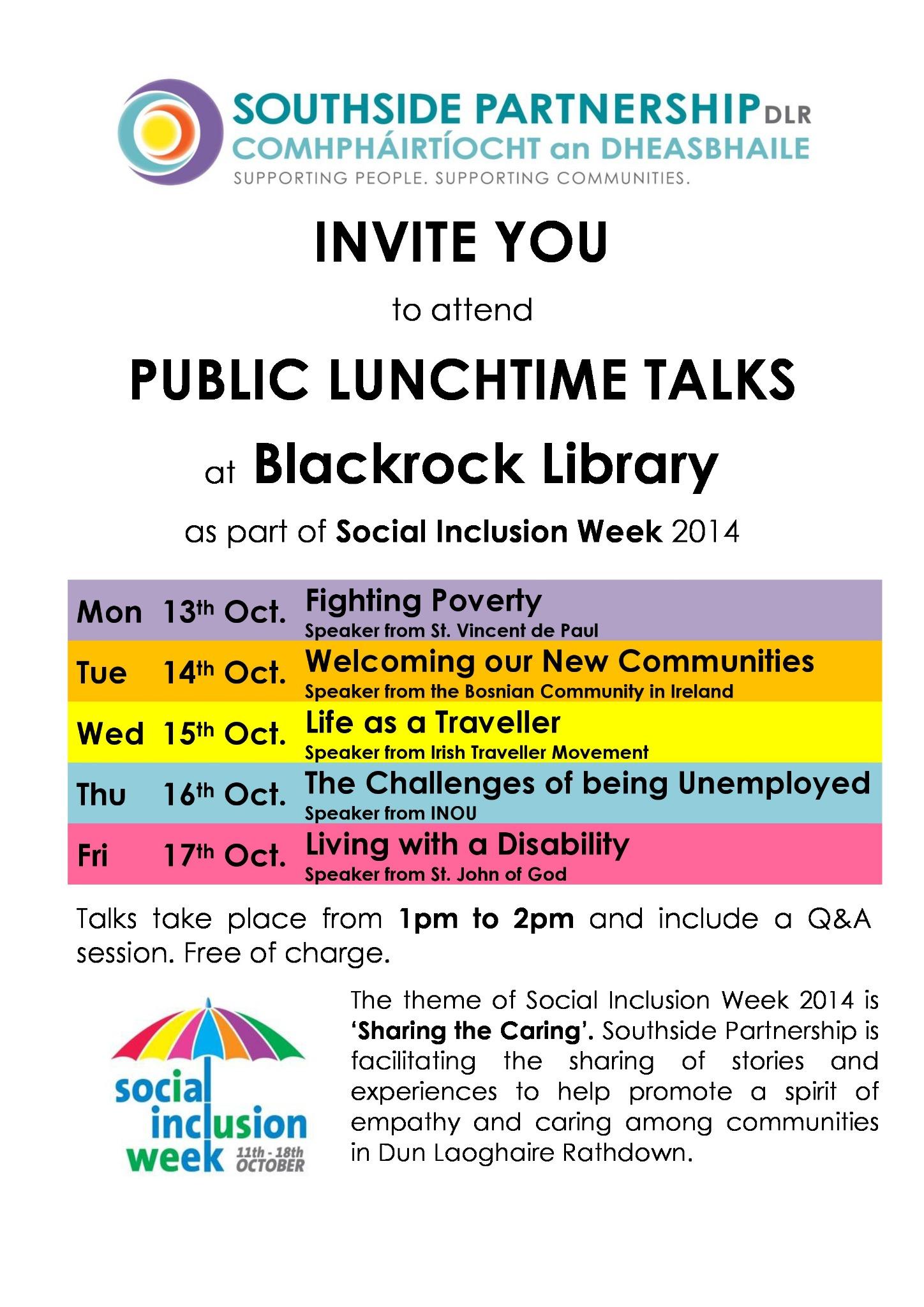
Southside Partnership are running a series of lunch time talks (1pm - 2pm) during Social Inclusion Week 2014 in Blackrock Library. 
Events are free and all are welcome.
Embedded image permalink


For Children's Book Festival this month we have free events running in all our branches for Kids. Please ring your local branch to book or check out our newsletter online:   http://www.dlrcoco.ie/library/news/2014/News_Events_Autumn_Winter14.pdf


Monday, September 22, 2014

Essential or Extravagant? The New Dublin Libraries

2014 saw the (re)opening of two new libraries in Co. Dublin: Dún Laoghaire andBlackrock, two exciting but expensive projects that generated some controversy. Do we need more libraries built in the age of technology, with its ecological concerns about paper production and where Amazon sells more electronic than paper books? Well, it depends on what you mean by “library”.
The new Dún Laoghaire library, inaugurated on today’s Culture Night, the result of a €36m mammoth project and an outstanding example of ultra-modern Scandinavian-style architecture, is called a cultural centre and will comprise a café, gallery space, an auditorium, a crafts workshop and a children’s library. Once finished, it will open six days a week, with four late evenings. Rebranded the “DLR Lexicon”, it’s equipped with mobile computers and room space for meetings, events and activities to be used free by schools, book clubs, community groups, artists.
The new, refurbished Blackrock library opened on Bloomsday as part of a new complexhousing the original Town Hall and the new Blackrock Further Education Institute, a combined renovation/conservation project, where original features have been retained and restored. The library itself, open late two days a week, now has state-of-the-art IT facilities, a dedicated children’s section, and modern mezzanine study space plus separate reading room – a student’s dream.
When I visited these new buildings, the first thought that came to my mind was that they are the new Starbucks – a hilarious and ironic reversal of roles that somehow makes sense. They are places where you go to study, enjoy a little quiet time, flick through some magazines, work on your laptop, do research, join your friends for a bookish meet-up over gourmet coffee – free, modern, relaxing oases right in the middle of buzzy town centres and within walking distance from your home. The question is though, did we really need them and can we justify the costs of (re)building them?
Questions have been asked about the sustainability of traditional libraries for a long time. With the world at your fingertips thanks to online book archives and electronic bookreaders, who will actually use these buildings? Plenty of people, turns out. Students going to central Dublin colleges might appreciate not having to trek all the way into town to exchange their books. Older people enjoy the company of other readers and a free read of the day’s papers in a nice location not far from their home. And, finally: children. Most parents will have a bookcase brimming with books at home, but nothing compares to a visit at the library; seeing the expression on kids’ faces at the sheer volume of books and the impressive interiors where everybody is reading in silence is priceless. Even office workers could use their lunch break for a well-deserved literary breather over a nice cuppa – without the queues and white noise. See?  Starbucks!
Culture and literature are not material, but they need material investment, which is why I hope that these libraries will do well. And if you need a reminder as to why we need libraries, here is a short list of reasons:
-       They cost nothing (unless you’re late and they fine you): you don’t have to buy books you don’t like; you don’t have to buy books at all. They don’t discriminate: evenbroke geeks can afford the library.
-       They encourage reading: once you’re in, you have to read (most effective way to get children to read – fact). If you like a book, you tend to read more by the same author.
-       Great place to do your research. Librarians will help you find sources, get the books you want from another library and often point you in the right direction.
-       They’re about the only remaining places that offer free meeting space.
-       They have music, films and e-books, too.
-       They entertain your children with free activities and get them to read.
-       They are beautiful.
So Hurray! for the libraries, because without them, “we'd be dumb!”
Haven’t made plans for tonight yet? Our Culture Night musts will help.

Wednesday, September 10, 2014

On Friday 12th September 2014 at 5pm 

Dún Laoghaire Library will close. 

The Library will re-open in dlr LexIcon later this year.


 Please use the services of any other dlr Libraries during the closed period to borrow and return items, or renew items online at www.dlrcoco.ie/library

Inside dlr LexIcon

Rick O'Shea, 2FM DJ has written about the dlr LexIcon, 


'I live in Dun Laoghaire so I was honoured to be asked did I fancy a scoot around the soon to be opened new public library on the seafront.
To be honest I’ve been gawking at the construction for many, many months walking by and it’s been the subject of controversy locally, much of which I think will evaporate once locals get their hands on what is a gob-smacking building.
As an amateur architecture nut I can safely say it is probably the most incredible indoor public civic space I’ve ever been to in Ireland and rivals anything I’ve ever seen in Europe. Acres of bookshelves, huge areas to sit and read or work, conference rooms for book groups, local businesses and community groups, a café on the ground floor, performance spaces, exhibition galleries, even as you can see further down, 24 hour automated book tellers.
All of this comes with a huge public outdoor open space that is designed to tie the seafront with the much neglected western part of George’s Street.
It is *stunning*. Click on any of the photos for a larger version.
When it opens it’ll be a world-class amenity for anyone who lives in Dublin to come, read, bring the kids, wander round, spend a few hours…
Some of it will be open for this weekend’s Mountains To Sea Festival, the rest soon. When it is, you’ll be gobsmacked'...http://www.rickoshea.ie/

Monday, August 11, 2014

New e-audiobook titles available from dlr Libraries website


OneClickdigital is a dynamic collection of Clipper unabridged audiobooks available from dlr libraries website


The collections of Adults, Kids and Teens audiobooks are regularly updated, with new titles being added each month. All you need is your library card number and pin number to access the collection and begin downloading. This month the following titles have been added to the collection: 

Lone Wolf by Jodi Picoult

Dead Letter Drop by Peter James

Summer at the Lake by Eric James.

New junior titles include Oliver and the Seawigs by Philip Reeve and Islands of Chaldea by Diana Wynne Jones.